
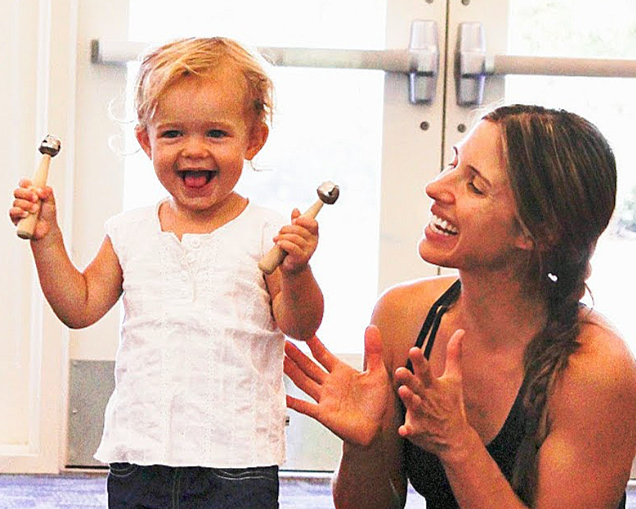
If you've ever watched a toddler stop mid-tantrum because a familiar song came on, you've seen a small preview of something researchers have been studying for decades: music doesn't just entertain young children. It builds their brains.
For parents weighing whether a weekly music class is "worth it" alongside naps, snacks, and every other demand on a small child's schedule, here's what's actually happening during those 45 minutes of singing, drumming, and dancing together.
The early years are when the brain is doing its heaviest lifting
A young child's brain forms new neural connections faster in the first few years of life than at any other point. Music engages an unusually wide swath of the brain at once — areas responsible for hearing, movement, memory, and emotion all activate together during a simple activity like clapping to a beat or matching pitch in a song.
That's part of why music is so often described as a "whole-brain" activity. It's not just an auditory experience; it's a coordination exercise, a memory exercise, and an emotional one, all layered into something that feels like play.
It builds skills that show up far outside of music
Parents are sometimes surprised to learn that early music exposure is linked to gains in areas that have nothing to do with singing or instruments:
Language development. Songs are naturally repetitive and rhythmic, which helps young children absorb new vocabulary and sentence patterns. Call-and-response songs in particular mirror the back-and-forth structure of conversation.
Early math thinking. Rhythm is pattern, and pattern is math. Counting beats, noticing repetition, and recognizing "same vs. different" in a melody all draw on the same cognitive skills used later in basic math reasoning.
Self-regulation. Action songs that require a child to start, stop, speed up, or slow down on cue are quietly teaching impulse control — the same skill that helps later with waiting turns, following classroom routines, and managing big feelings.
Fine and gross motor skills. Shaking an instrument with a steady beat, marching, or passing an object during a circle game all build coordination in a way that feels like pure fun.
The social piece matters just as much as the musical piece
A group music class is often a young child's first regular experience being part of a "crowd" outside the family — sitting in a circle, waiting for a turn, watching what other children do and copying it. For toddlers especially, this kind of low-pressure group exposure builds comfort with other children and adults well before preschool starts.
It's also one of the few activities where a parent and child are learning something together, at the same pace, side by side. That shared novelty — neither of you has done this exact song before — creates a different kind of bonding than routine daily care does.
You don't need a "musical" family for this to matter
One of the most common hesitations parents have is: I'm not musical myself — will my child actually get anything out of this?
Young children don't need a trained singer next to them. They need a present one. Early childhood music research consistently points to engagement, not skill, as the key ingredient — a parent singing slightly off-key while fully present is doing exactly what a child's developing brain needs. The class structure and the teacher carry the musical expertise; your job is simply to show up and participate.
What this looks like in practice
In our Family Music classes, a typical session moves through:
Greeting songs that help children (and grown-ups) settle in and know what to expect
Rhythm play with hand instruments, building coordination and beat awareness
Movement songs that combine gross motor skills with following multi-step directions
Quiet, calming songs that help children practice transitioning from high energy to stillness — a skill that pays off well beyond the music room
None of it requires a musical background, and none of it feels like "practice." It feels like play — which is exactly the point.
The bottom line
You're not just filling a weekly time slot. You're giving your child repeated, low-stakes practice in language, coordination, self-regulation, and social connection — wrapped in something they'll ask to do again next week.
Classes run in 6-7 week sessions throughout the year. You can find a session near you in Encinitas or San Marcos.